Every hiring team is asking some version of this question, and most vendors answer it with a feature list. Suspicion scores, tab-switch monitoring, keystroke analysis, webcam proctoring, plagiarism databases.
The more useful question is not what detection exists. It is how well it works, and who it gets wrong.
The best data we have comes from a company that sells detection#
In early 2026, Fabric, an AI interview platform that also sells cheating detection, published an analysis of 19,368 interviews conducted between July 2025 and January 2026. That last detail is what makes the findings unusually credible.
Then the finding that undercuts the entire category:
More than 61% of flagged candidates still cleared the platform's own pass bar.
Read that again. Of the people the detection system identified as cheating, most passed anyway. The detector produced a label that did not change the outcome. It generated suspicion without generating a decision.
That is a strange thing for a detection product to publish about itself, and Fabric deserves credit for publishing it.
The false-positive problem, and an honest caveat#
Here is where I have to be careful, because the strongest research on detector accuracy is about AI-written text, not code.
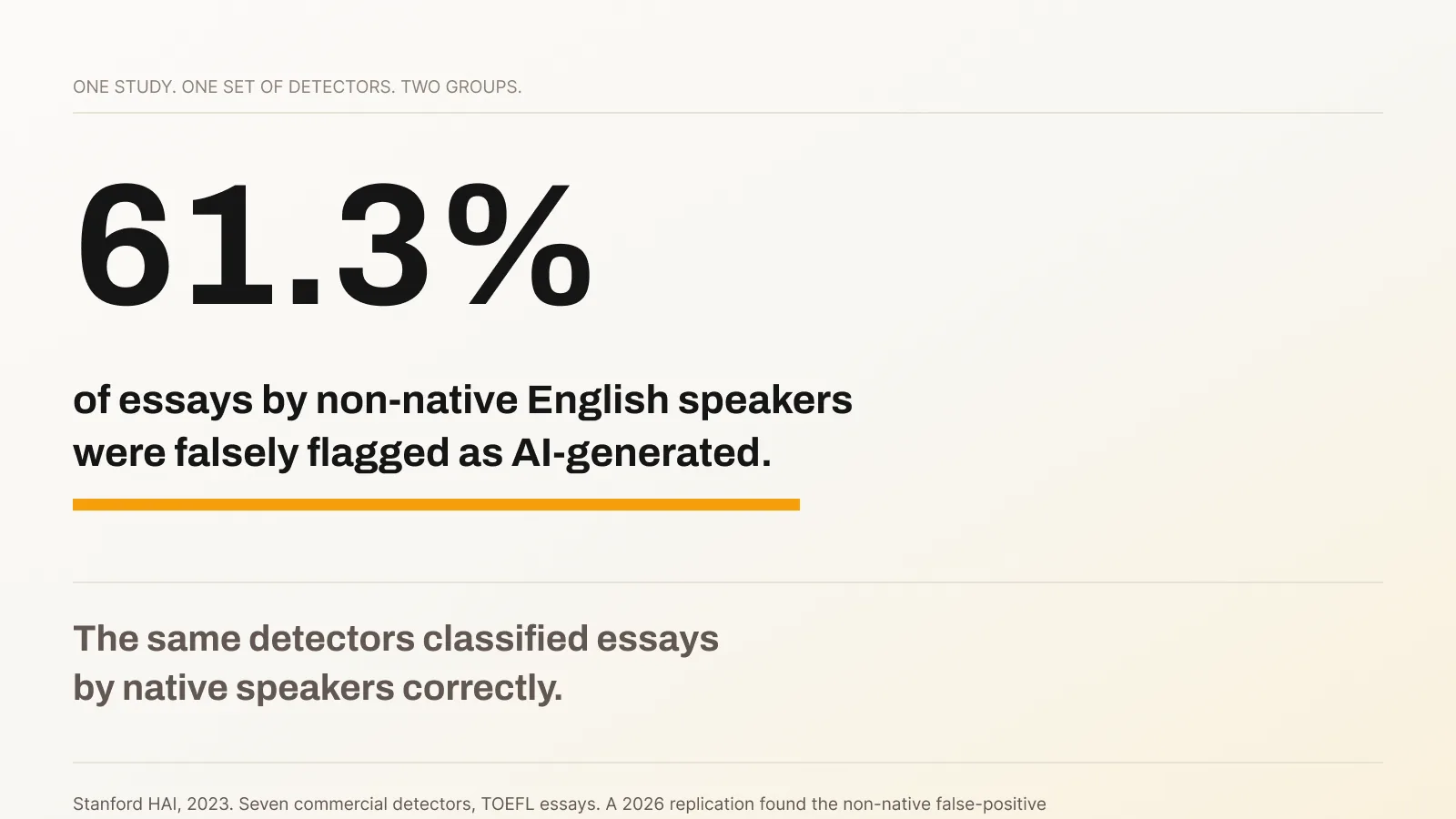
In academic writing, the record is bleak. Turnitin quietly revised its own false-positive rate from under 1% to roughly 4% at the sentence level in 2023. Independent 2026 analyses put commercial detectors below 60% accuracy, with false-positive rates of 5 to 20% on native English writing.
Then there is the finding that should stop anyone hiring internationally:
None of this requires a webcam. It requires an environment where real work is possible and observable.
The bottom line#
Detection is expensive, unreliable, biased in a direction that matters, and, on its own vendors' numbers, frequently irrelevant to the outcome anyway.
The industry has spent enormous engineering effort building surveillance around a test whose predictive value was never established in the first place. That is two unproven things stacked on top of each other.
You never wanted to know whether a candidate used AI. You wanted to know whether they can do the job. Those stopped being the same question the moment AI became part of the job. The good news is that the second question is far easier to answer than the first.
Sources: Fabric, State of AI Interview Cheating 2026 (19,368 interviews, July 2025 to January 2026) · Stanford HAI TOEFL false-positive study · 2026 ACL Anthology replication · Turnitin published false-positive revisions · UCLA HumTech · CodeSignal 2025 assessment fraud release · Karat 2026 engineering leader survey