In 2004, Google had roughly 3,000 employees and was building search infrastructure largely from scratch. A whiteboard question about graph traversal was a fair proxy for the work, because the work genuinely was algorithms.
Today an engineer spends the day somewhere else entirely. Reading code they did not write. Tracing failures across services they half understand. Reviewing pull requests, triaging alerts, and directing AI tools through most of it. Writing a novel algorithm from scratch has become a rare event.
Technical hiring never followed. We still screen for the 2004 job.
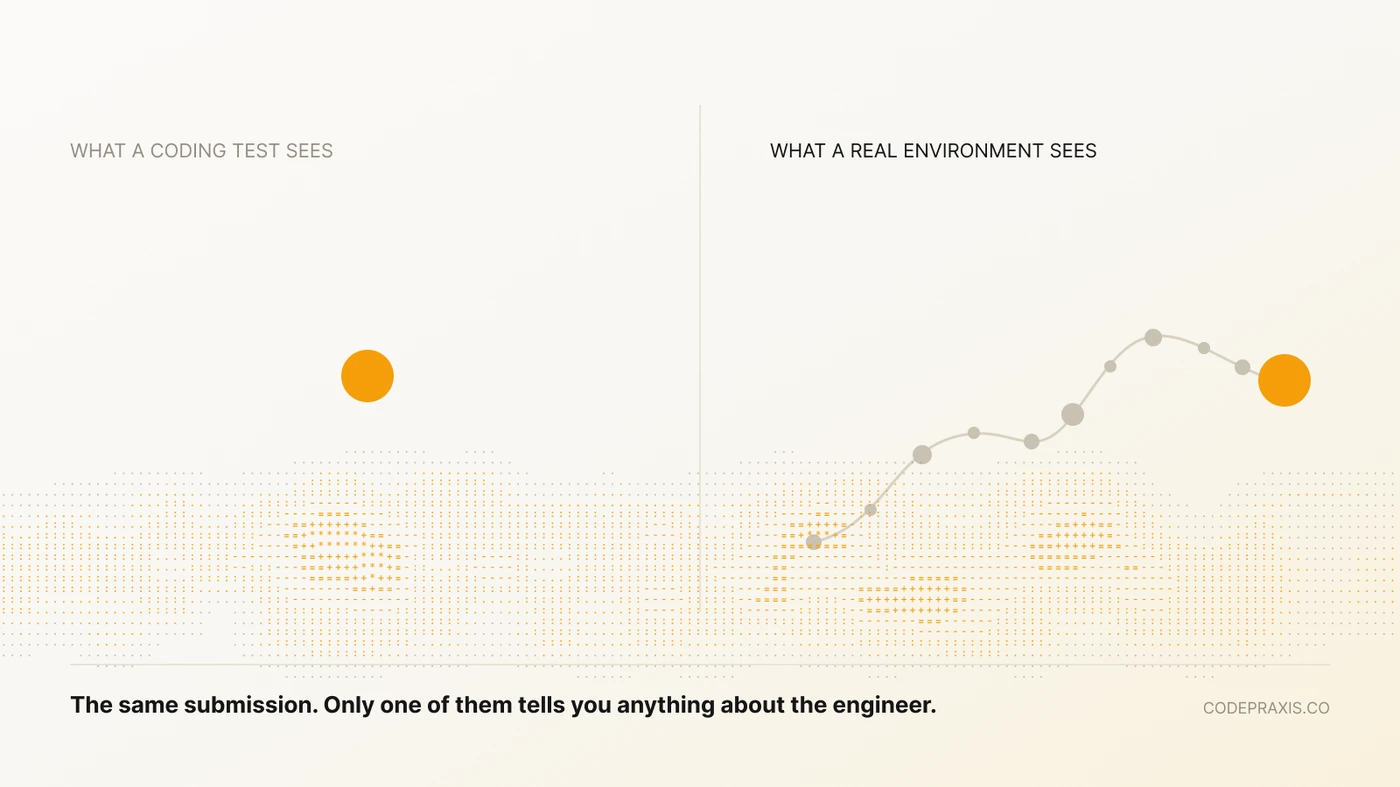
Google measured it and said so out loud#
In 2013, Laszlo Bock, then Google's Senior Vice President of People Operations, told the New York Times that the company had compared interviewer scores against actual job performance across tens of thousands of interviews.
His summary: zero relationship. Brainteasers, he said, were "a complete waste of time."
Google dropped the brainteasers. The algorithm question survived anyway, not because any data rescued it, but because it was familiar, standardised, and easy to scale.
The research hierarchy has been settled for decades#
Schmidt and Hunter's meta-analysis of 85 years of hiring data put work-sample tests at the top: assessments where a candidate performs tasks resembling the actual job. A 2016 update revised that number downward, and work samples still outranked most alternatives.
What no update has ever produced is a validity figure for the algorithm interview itself. It has never been isolated and measured against on-the-job performance in the peer-reviewed record.
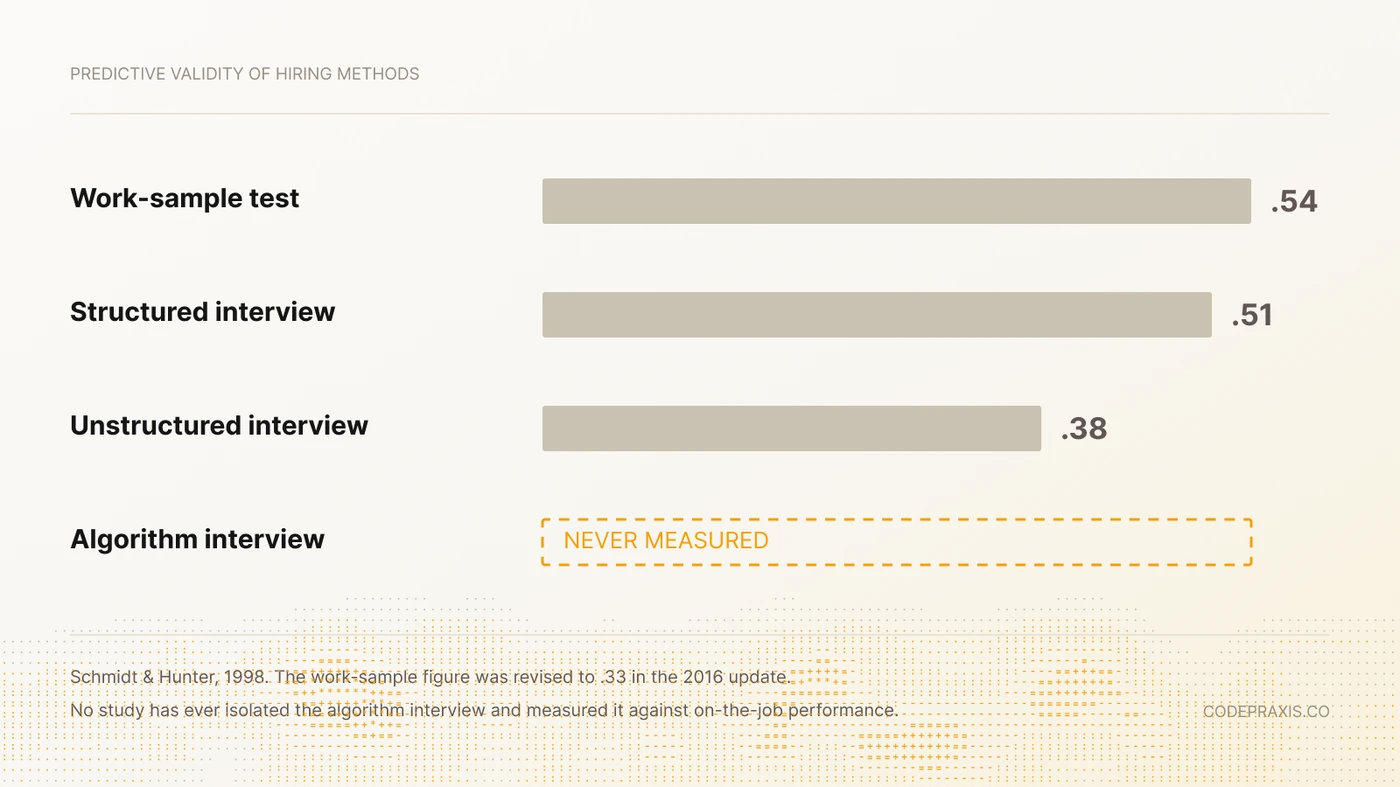
You do not have to take our word for it. Codility, one of the largest technical assessment platforms in the world, publishes this on its own website:
Every vendor talks about predicting job performance. No vendor publishes the evidence.
That includes us.
Candidates worked it out before the buyers did#
HackerRank's own 2025 Developer Skills Report found that 56% of developers consider algorithm questions irrelevant to their jobs, and 78% say assessments do not align with real work.
When most of your pipeline thinks the test is pointless, the strongest engineers do not complain. They stop replying.
Then AI removed whatever was left#
Every question in every major public bank has been solved, posted, and indexed. CodeSignal reported that assessment fraud more than doubled during 2025. Karat found that 71% of engineering leaders now say AI has made technical skills meaningfully harder to assess.
The industry answered with proctoring. Webcams, tab-switch detection, keystroke analysis, suspicion scores. An enormous amount of engineering spent protecting a test that had no demonstrated predictive value before AI arrived.
It also answers the wrong question. You never wanted to know whether a candidate used AI. You wanted to know whether they can do the job. Those stopped being the same question the moment AI became part of the job.
What replaces it#
Work-sample assessment is not a new idea. What is new is that it is finally practical at scale.
A real-world coding assessment now means the candidate opens a link into a working machine with a genuine multi-file project: a terminal, a test suite, git history, and AI tools available, the same setup they would have on their first morning. The task is to understand code they did not write, fix something that spans several components, and extend it in a way that fits the existing patterns.
It also reaches roles the industry quietly gave up on. Assessing a machine learning engineer, or firmware, or robotics, needs real hardware rather than a browser tab, which is why those candidates have been screened with conversations and gut calls for years.
You still do not get a validated score. Nobody can honestly offer you one. What you get instead is the work, and your own judgment applied to it, the way you would read a pull request from someone already on your team.
That is not a better number. It is the removal of the number.
Sources: Laszlo Bock, New York Times, 2013 · Schmidt & Hunter 1998; Schmidt, Oh & Shaffer 2016 · Codility assessment-validity page · HackerRank 2025 Developer Skills Report · CodeSignal 2025 assessment fraud release · Karat 2026 engineering leader survey