The jobs exist. The skills exist. What's missing is a way for either side to believe the other.
In the same week, you'll hear two complaints. Talent acquisition teams say they can't find suitable candidates. Applicants say they've sent three hundred applications and heard nothing back.
Both can be true at once. In July 2026, US employers still listed 7.3 million job openings, yet the hiring rate was just 3.2%. In February it touched 3.1%, the lowest since April 2020. Plenty of roles are being posted. Far fewer are turning into offers.
That isn't simply a candidate shortage or a job shortage, and the headline numbers can't tell you exactly what it is. But when roles stay open, applications keep climbing and hiring still crawls, something between the two sides is breaking. Follow the hiring funnel and you can see where.
1. The front door is flooded#
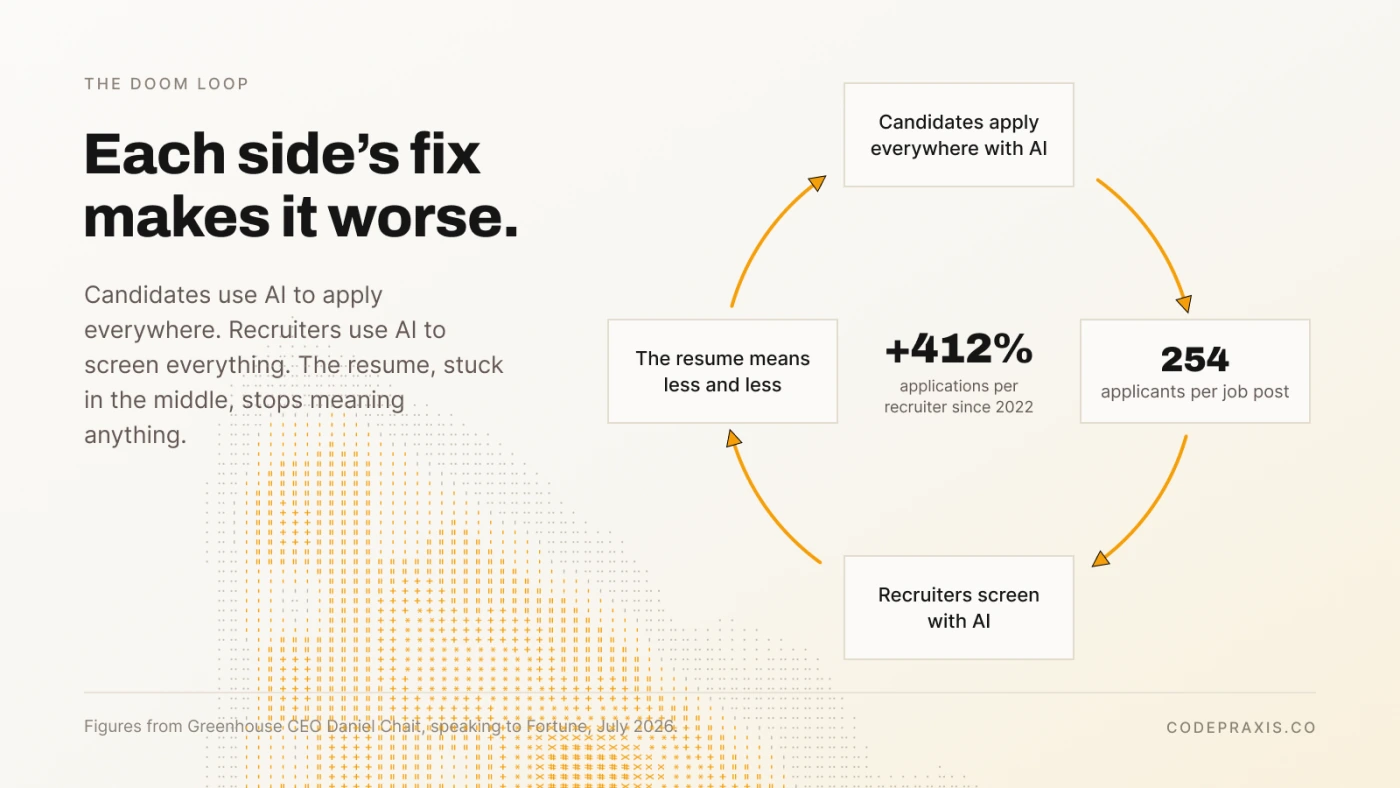
The average job posting on Greenhouse now draws 254 applicants, and applications per recruiter are up 412% since 2022, according to the company's CEO, Daniel Chait. Part of that rise is smaller recruiting teams, not just more applications. But the volume is real: tools that cost about $20 will apply a candidate to every job on the platform automatically.
Handshake saw the same pattern with students. Between August 2024 and August 2025, postings on its platform fell 16% while applications per role rose 26%.
Recruiters answer the flood with AI screening, because nobody reads 254 applications by hand. Candidates answer the screening with more AI applications. Chait calls it a doom loop, with each side's fix making the whole system worse. It's no surprise candidate ghosting runs both ways: recruiters can't reply to everyone, and applicants who apply everywhere can drop out just as quietly.
2. So the resume stopped meaning anything#
When the same tools write, tailor and submit every resume, the resume can't tell a recruiter who can do the job. Every one lists Python, React, problem solving, team player.
This isn't a collapse in applicant quality. It's a signal failing. A document anyone can make perfect tells you nothing about actual work ability.
3. So screening fell back on shortcuts#
When the application stops working, screening falls back on whatever is easy to check: a degree, a college name, the brand recognition of your last employer, a keyword match, or a thirty-minute call about culture fit, where interview bias does most of the deciding.
Job requirements drift the same way. Postings describe a unicorn candidate who ticks fifteen boxes, then filter out anyone whose resume doesn't mirror the list. A keyword mismatch gets mistaken for a skill mismatch.
Companies know these shortcuts are unfair, and many announced they'd drop them. Harvard Business School and the Burning Glass Institute checked what happened. When US firms removed degree requirements, fewer than 1 in 700 hires actually benefited. Most firms changed the job posting and kept hiring the same way.
4. And the first rung got thinner#
Entry-level applicants get hit hardest. They have the least experience, the fewest references, and nothing for a shortcut to latch onto.
Stanford's Digital Economy Lab found employment for 22 to 25 year olds in the most AI-exposed jobs has fallen about 19% behind young workers in less exposed ones, mainly because companies are hiring fewer of them. In Handshake's survey of the Class of 2026, 61% of students were pessimistic about their careers, and three quarters of those pointed to companies hiring fewer entry-level workers.
The missing puzzle piece: evidence both sides trust#
Put those four together and they're symptoms of one thing.
Economists call it information asymmetry, and George Akerlof, Michael Spence and Joseph Stiglitz shared the 2001 Nobel Prize in economics for explaining it. The candidate knows what they can do, and the company can't see it. The company knows what the role actually needs, and the job posting rarely says. Spence's classic example was the job market itself: when employers can't observe ability, they lean on credentials as a stand-in.
Hiring has lost its trusted signal of what a person can actually do.
Without it, candidates can't prove themselves, so they apply everywhere. Companies can't tell who's good, so they screen on shortcuts. The shortcuts exclude capable people and let polished applications through. Both sides add more AI, and the signal gets weaker still.
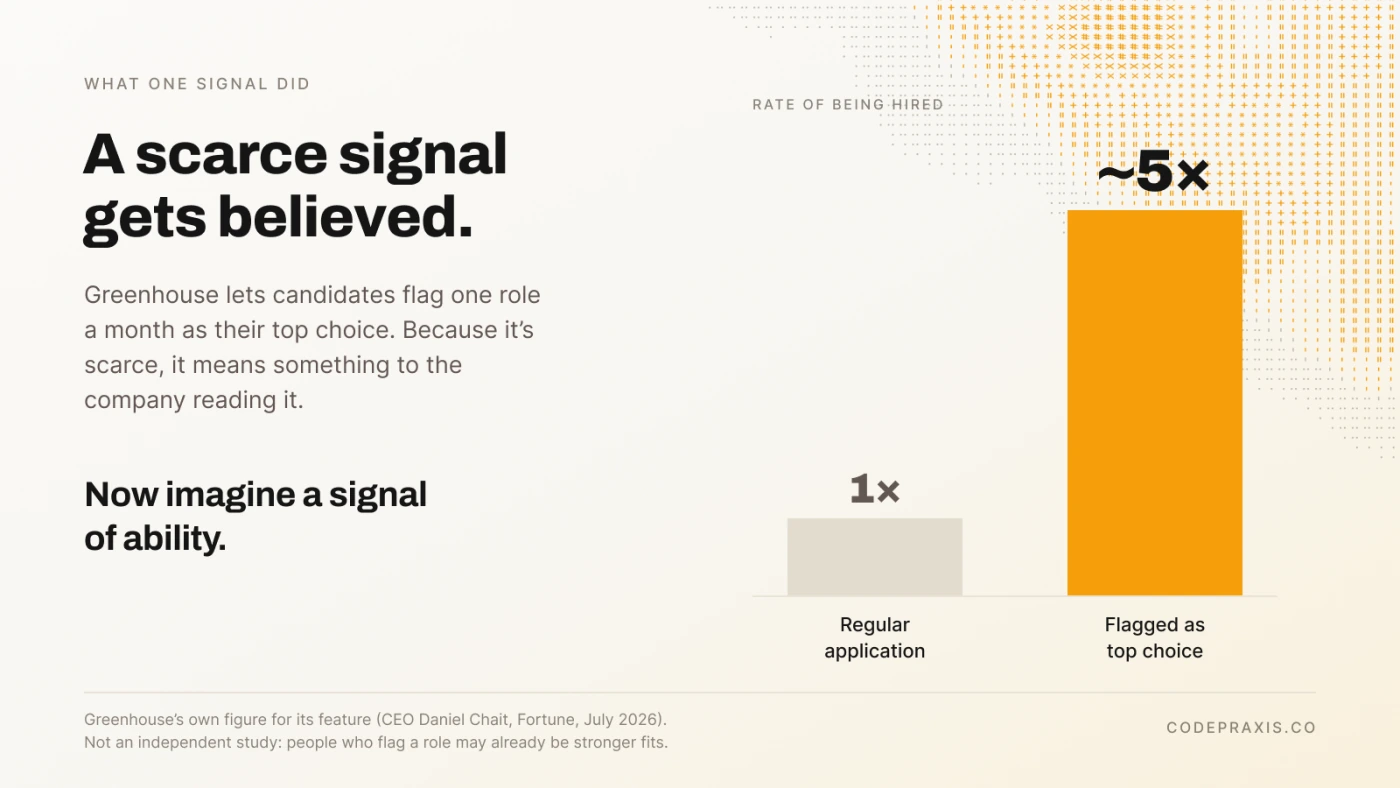
There's an early hint of what a real signal can do. Greenhouse now lets candidates flag a single role a month as their top choice. Because it's scarce, it means something, and the company says those applicants are hired at roughly five times the usual rate. Treat that with caution: it's Greenhouse describing its own feature, and people who flag a role were probably stronger fits to begin with. But it shows employers respond when a signal is scarce enough to trust.
That's a signal of intent. A credible signal of ability could do far more.
What fills it#
Bring proof someone can open#
Apply to fewer jobs, on purpose#
Treat a practical task as a chance, not a hurdle#
Ask what the first 90 days look like#
If you're hiring
- Start from outcomes, not requirements. Write down the expected outcomes for the first 90 days, then test for those. That's outcome-based hiring, and it shrinks a fifteen-box wish list to what the role needs.
- Look at work earlier, not last. A short screening call followed by a practical task is fairer than three rounds of resume filters, and usually faster. If the work sample only comes at the end, the people it would have found are already gone. Save reference checks and background checks for finalists.
- Replace filters, don't just remove them. Deleting "degree required" changes nothing if nothing takes its place.
- Use structured hiring. Give every candidate the same task, the same rubric and the same hiring standards, so you're comparing like with like. It leaves less room for interview bias, and fewer poor matches reach the final round, which is where recruitment efficiency is really won or lost.
- Keep it bounded and respectful. Ninety minutes on a realistic problem, or a paid trial project for senior roles, tells you more than an unpaid weekend take-home nobody reads.
This matters most for startups, agencies and small teams. You can't outbid large companies on salary, benefits or brand recognition. The candidates who choose you need a process that can see what they can do, not where they've worked, and you need to judge who will perform without a famous employer on the resume to lean on.
Our disclosure#
We build CodePraxis, which runs skills assessments on a real machine and gives you the work itself and a structured scorecard, instead of a percentile. So yes, we have a stake in this argument.
We're one way to base candidate evaluation on evidence, not the only one. A portfolio review, a paid trial project, or structured work samples all do the same job. What doesn't work is waiting for the resume to start meaning something again.
The bottom line#
People aren't struggling to get hired because the jobs have vanished, or because they can't do the work. They're struggling because the two sides can no longer see each other. The resume became noise, screening got stricter, and the first rung got narrower.
The missing piece is evidence. Whoever brings it to the hiring process first, candidates or companies, stops being stuck.
Sources: US Bureau of Labor Statistics, Job Openings and Labor Turnover Survey, July 2026 (released 1 September 2026), and February 2026 · Fortune, interview with Greenhouse CEO Daniel Chait, 27 July 2026 · Handshake, Class of 2026 outlook · Burning Glass Institute and Harvard Business School, Skills-Based Hiring: The Long Road from Pronouncements to Practice, 2024 · Stanford Digital Economy Lab, Canaries in the Coal Mine?, August 2026 update · The Nobel Prize, Economic Sciences 2001